Trust Is All You Need
Please Stop. Pay Attention To These Signals... Your Family May Depend On You Reading It And Making A Choice About What You Will Do Next.

This post is primarily focused on our Acton and its local community, but is included in the Family Friendly Fort Lauderdale ecosphere because… the steps we are currently taking with FFFTL will be part of the bigger solution.
When the “experts”(meaning, those closest to the work) say something big is happening (if you haven’t seen this link, start here), my approach is to do two things:
Get curious and watch closely so I can gather information;
Step back and take it all in first, so I don’t get reactive.
A first draft of this post was originally emailed to group of fellow Acton owners after a discussion about the future of our schools and the bigger future of the Acton Network. It is a letter meant to be both a wake-up call and one full of hope.
You get to choose which will serve your family most.
“Imagine it’s 2029.
Half the parents at Acton Academy Fort Lauderdale who we used to rely on for tuition are ‘unemployed.’ But... they’re still ‘okay.’ They’re consulting, freelancing, piecing it together. Income is down 20–40%. But these families are doing better than ever.
Their child’s school choice become the solution.
At the same time that AI begins to make a lot of white-collar work cheap. Some parents ask a brutal question:
‘How can I keep paying for this school I love when our own income feels threatened?’
The fork in the road becomes real.
Learning that is basically just content delivery get priced like content.
Cheap. Replaceable.
Schools that are identity + tribe + standards + trust become priceless, because they help families stay functional and connected during chaos.
So the question for Acton isn’t ‘How do we run better schools next year?’
It’s ‘How do we become the most trusted institution in a family’s life, after church and before their bank?’
Let’s get started (if you haven’t already seen this) here’s the full Centrini Research.

TL/DR: Here’s a summary of the Cintrini Research as it relates to our school and our families.
We will soon be living in a “Ghost GDP” World
The Scenario in One Line
If AI makes white-collar “thinking work” cheap, incomes compress and spending weakens. In that world, organizations competing on features get priced like content. Communities that function as tribes become essential.
1) The Two Impending Futures: Choose The Game That Will Serve Your Family Best
Future A: The “Content School”
Parents’ income becomes volatile (down 20–40% for many).
They ask: “What am I paying for?”
School answers: curriculum, apps, credentials.
Parent conclusion: “We can get this cheaper. Maybe even do it ourselves.”
Result: slow churn, then sudden collapse.
Future B: The “Trust Engine School”
Parents’ income becomes volatile.
School answers: identity, community, standards, mutual aid, apprenticeship pathways.
Parent conclusion: “This keeps our children grounded, prepared, and our family connected.”
Result: Acton becomes the last expense they will want to cut.
Punchline: In a downturn, features get cut. Tribes don’t.
2) The One Number That Predicts Resilience
Trust Density Score (TDS)
TDS = meaningful parent-to-parent touches per family per month
Meaningful = actual help, collaboration, hiring, mentoring, buying/selling, childcare swaps, referrals.
Benchmarks
0–1/month = tuition is just a transaction
2–3/month = community-ish
4–6/month = a resilient community
7+/month = the antifragile community
Interpretation
If TDS is low, you don’t have a community. You have a customer base.
3) The 5-Minute Campus Audit (We Are Doing This Today)
Write real numbers, not vibes:
Tuition Fragility
How many families would struggle if income dropped 25% for 12 months?
Community Liquidity
How many families can offer paid services to their fellow Acton families (legal, design, marketing, childcare, coaching, wellness, trades, etc.)?
Trust Density
What’s your current TDS guess?
If we can’t answer these, we’re running today’s playbook for tomorrow’s weather.
4) The Acton Anti-fragile Next Steps (started in Spring 2026)
Increase TDS by +2 next month. One ritual, implemented immediately.
High-leverage rituals:
Parent skill directory + “Hire Inside” pledge
Mutual Aid Friday (needs posted, offers posted, matched live)
Apprenticeship Exchange sourced from parent businesses
3-intro rule (3 useful intros per family per quarter)
Founders’ dinner quarterly (give-first norm)
Goal: Turn every campus into a small, high-trust economic network that produces agency in learners and optionality in families.
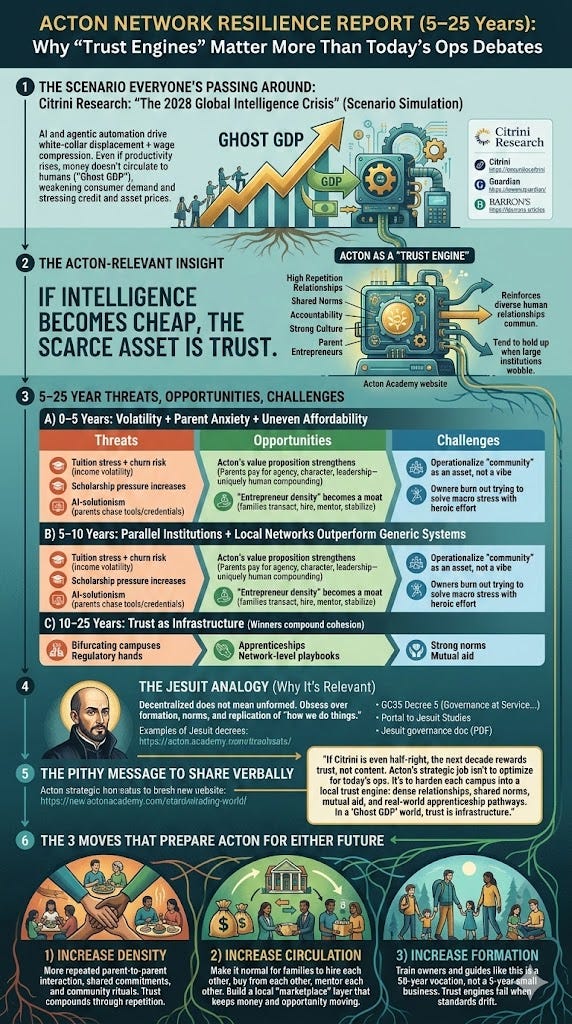
Acton Network Resilience Report (5–25 Year Projection)
Why “Trust Engines” Matter More Than Today’s Ops Debates
1) The Scenario Everyone’s Passing Around
Citrini Research: “The 2028 Global Intelligence Crisis” (this is a scenario simulation, not a prediction)
Here’s The Core Claim (in plain English)
AI and agentic automation drive white-collar displacement + wage compression, so even if productivity rises, money doesn’t circulate to humans (“Ghost GDP”), weakening consumer demand and stressing credit and asset prices.
Helpful mainstream context on how viral this became (for people who won’t read Substack):
The Guardian explainer (Feb 24, 2026): https://www.theguardian.com/technology/2026/feb/24/feedback-loop-no-brake-how-ai-doomsday-report-rattled-markets
Barron’s pushback framing it as a recurring “doomsday memo” pattern (Feb 25, 2026): https://www.barrons.com/articles/ai-economic-collapse-citrini-stock-market-50378a1d
2) The Acton-Relevant Insight
If intelligence becomes cheap, the scarce asset is trust.
Acton is already a “trust engine” (high repetition relationships, shared norms, accountability, strong culture, parent entrepreneurs). That’s exactly what tends to hold up when large institutions wobble.
3) 5–25 Year Threats, Opportunities, Challenges
A) 0–5 years: Volatility + parent anxiety + uneven affordability
Threats
Tuition stress + churn risk as more families face income volatility (even if unemployment stats understate it). (citriniresearch.co
Scholarship pressure increases (more “we love you, but…” conversations).
AI-solutionism: parents chase tools and credentials instead of culture, agency, and community.
Opportunities
Acton’s value proposition strengthens: in an AI world, parents will pay for agency, character, self-management, leadership (uniquely human compounding).
“Entrepreneur density” becomes a moat: families transact, hire, mentor, and stabilize each other (local circulation).
Challenges
You must operationalize “community” as an asset, not a vibe.
Owners burn out if they try to solve macro stress with heroic personal effort (spoiler: they can’t).
B) 5–10 years: Parallel institutions + local networks outperform generic systems
Threats
Bifurcation across campuses: strong-trust campuses thrive; weak-trust campuses become tuition-fragile.
Regulatory attention rises as governments scramble for levers, and education is always a lever.
Opportunities
Acton becomes a community institution, not just a school: apprenticeships, parent talent networks, micro-enterprise, mentorship ladders.
Network-level advantages become decisive: shared playbooks, shared leadership formation, shared “culture enforcement” patterns.
Challenges
Maintaining decentralization while preventing “brand drift” and uneven quality.
Creating repeatable leadership formation (owners and guides) fast enough to keep up with growth and stress.
C) 10–25 years: Trust as infrastructure (winners are networks that compound cohesion)
Threats
Education splits into: community institutions vs luxury goods.
If “Ghost GDP” dynamics exist, many families will need a community to stay solvent, stable, and sane. (citriniresearch.com
Opportunities
Acton can become a centuries-long institution if we behaves like one:
mission clarity
local adaptability
leadership formation
strong norms
mutual aid across nodes
Challenges
The long game is governance and formation, not “better marketing.”
Without intentional structure, networks don’t scale trust. They scale variance.
4) The Big Takeaway
“If Citrini is even half-right, the next decade rewards trust, not content. Acton’s strategic job isn’t to optimize for today’s ops. It’s to harden each campus into a local trust engine: dense relationships, shared norms, mutual aid, and real-world apprenticeship pathways. In a ‘Ghost GDP’ world, trust is infrastructure.”
5) The 3 Moves That Will Prepare Our Acton (And Your Family) For Either Future
Increase Density
More repeated parent-to-parent interaction, shared commitments, and community rituals. Trust compounds through repetition.
Increase Circulation and Connections
Make it normal for families to hire each other, buy from each other, mentor each other. Build a local “marketplace” layer that keeps money and opportunity moving.
Increase Formation
Train owners and guides like this is a 50-year mission, not a 5-year small business. Trust engines fail when standards drift.
Here’s a Bit More Detail For Parents Who Feel This Just Cannot Be Happening
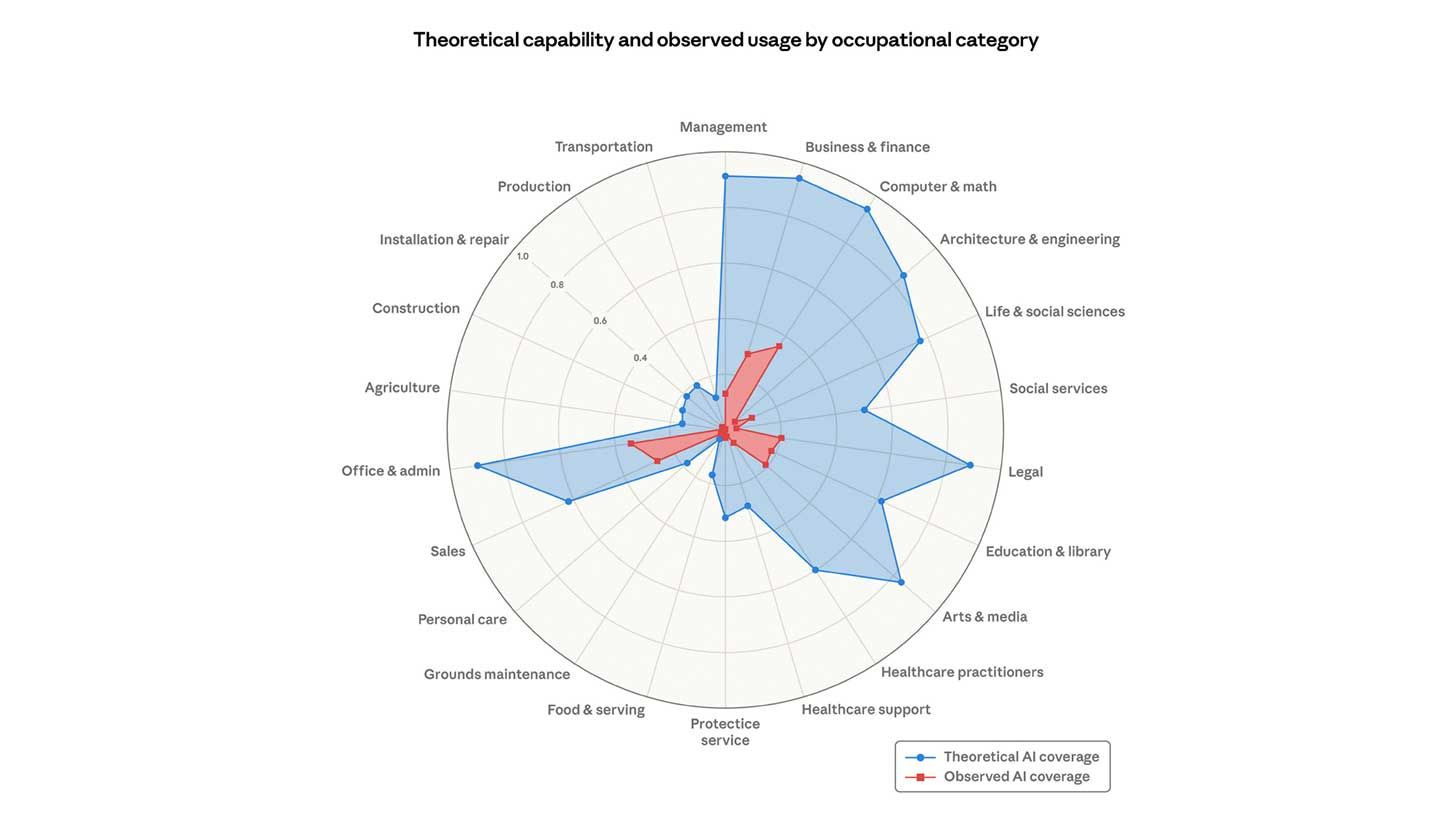
We’ve spent the last few years debating when AI will “take our jobs.” According to a recent study from Anthropic, that shift isn’t a looming shadow anymore—it’s already reshaping the entry-level market. By cross-referencing Claude’s actual capabilities with real-world usage, the study reveals a workforce in transition.
The Metrics: “Observed Exposure”
Unlike theoretical studies, Anthropic used a metric called “observed exposure.” This measures the overlap between tasks AI can do and the tasks users are already asking it to automate. It’s less about what might happen and more about what is happening in the trenches of the digital economy.
Who’s at Risk (and Who Isn’t)?
The data paints a clear picture of which industries are feeling the heat:
Computer Programmers: Topping the list with a staggering 75% task coverage.
Customer Service & Data Entry: Not far behind at 67%.
The “Safe” Zone: Roughly one-third of the U.S. workforce currently has zero AI exposure. These are primarily “hands-on” roles that require physical presence and manual dexterity—think bartenders, cooks, and lifeguards.
The “Silent” Impact on Gen Z
While we haven’t seen a massive, headline-grabbing spike in general unemployment since the 2022 launch of ChatGPT, the “squeeze” is happening at the bottom of the ladder.
Since late 2022, hiring for 22-to-25-year-olds in AI-exposed fields has dropped by 14%. Companies aren’t necessarily firing their veterans yet, but they are increasingly hesitant to hire the next generation for roles that an LLM can handle for a fraction of the cost.
The Bottom Line
Anthropic CEO Dario Amodei has been vocal about the coming disruption, and the market is listening—we’ve already seen industry stock prices dip following major Claude releases.
Despite these blinking red lights, the global economy remains drastically underprepared. We aren’t just looking at a future shift; we are witnessing the slow-motion closing of the door for entry-level white-collar workers. The question is no longer if the disruption is coming, but how we support a workforce that is already feeling the pinch.
The Generational Divide is Real
There is a growing “tech schizophrenia” in how we perceive these tools. Older generations often treat AI as a glorified search engine - Google with a personality. Meanwhile, Millennials and Gen Z are integrating it as a life partner: a companion, therapist, health coach, and tireless tutor.
This creates a massive friction point in our institutions:
Education: Educators fear AI is dismantling the foundation of learning, while the students using it argue it’s the most powerful educational tool ever conceived.
Corporate Policy: While companies and schools scramble to ban or block access, the individuals embracing the tech are essentially becoming superhuman, augmenting their output at a pace traditional structures can’t track.
The Great Divergence Is Already Started
The institutions haven’t caught up, and they likely won’t in time. This creates a definitive fork in the road. Over the next five years, the gap between those who leverage AI and those who resist it won’t just be a matter of preference, it will define the winners and losers of the new economy.
As Peter Diamandis keeps reminding us. Choose your side carefully.